
How to Recover Loan Fraud Money in India – Complete Legal Guide to Recover Money Lost in Fake Loan Scams
With the rapid growth of digital lending platforms, obtaining a personal loan has become easier than ever. However, this convenience has also resulted in a significant increase in loan frauds, fake loan applications, instant loan app scams, and advance fee frauds. Every year, thousands of people lose money after applying for fake loans or dealing with fraudulent lenders.
If you are searching for How to Recover Loan Fraud Money, this guide explains the legal process, immediate steps to take, and the precautions that can improve your chances of recovering your money.

What is Loan Fraud?
Loan fraud occurs when fraudsters deceive people by promising personal loans, business loans, home loans, education loans, or instant loans and then illegally obtain money or personal information.
Common examples include:
- Fake instant loan apps
- Advance processing fee scams
- Fake RBI approval claims
- Fake bank representatives
- Fake NBFC websites
- Loan insurance fraud
- Security deposit scams
- Loan verification charges
- Processing fee fraud
- KYC verification scams
Common Types of Loan Frauds
1. Advance Fee Loan Scam
The fraudster promises immediate loan approval but asks for:
- Processing fees
- File charges
- Insurance charges
- GST payments
- Security deposits
- Verification fees
Once the payment is made, the fraudster disappears.
2. Fake Loan Apps
Fraudsters create fake lending applications that collect:
- Aadhaar details
- PAN card
- Bank account information
- Selfies
- Contact lists
- Mobile permissions
Victims may later face harassment, blackmail, or unauthorized financial transactions.
3. Fake Bank Officer Scam
Cyber criminals impersonate employees of well-known banks and ask for OTPs, banking credentials, or advance payments for loan approval.
4. Social Media Loan Scams
Fraudsters advertise “Guaranteed Personal Loans” on Facebook, Instagram, Telegram, WhatsApp, or other platforms and lure victims into paying advance fees.
How to Recover Loan Fraud Money
If you have become a victim of a loan scam, immediate action is important.
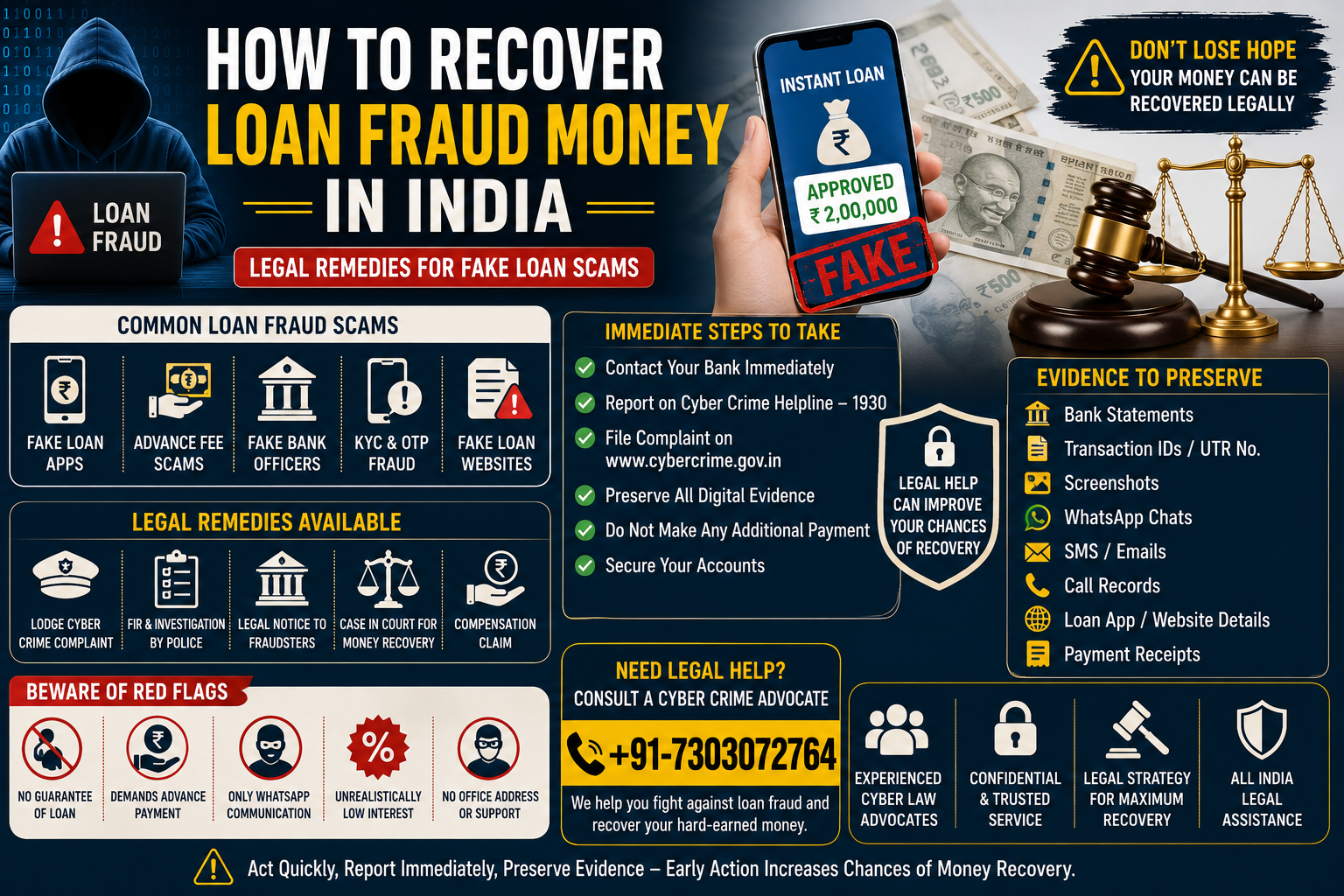
Step 1 – Contact Your Bank Immediately
Inform your bank about the fraudulent transaction and request them to:
- Record the complaint.
- Review the transaction.
- Take steps that may help prevent further unauthorized transfers, where possible.
Keep the complaint reference number safely.
Step 2 – Report the Fraud Immediately
Report the fraud without delay through the official cybercrime channels:
- National Cyber Crime Helpline – 1930
- National Cyber Crime Reporting Portal
Quick reporting can help law enforcement and financial institutions act before the funds are transferred further.
Step 3 – Preserve Digital Evidence
Collect and safely preserve:
- Bank statements
- Transaction IDs (UTR numbers)
- Payment receipts
- Screenshots
- WhatsApp chats
- SMS messages
- Emails
- Fake loan advertisements
- Website URLs
- Mobile numbers used by the fraudsters
Digital evidence plays an important role in cyber crime investigations.
Step 4 – Do Not Make Additional Payments
Fraudsters often demand more money by claiming:
- Loan approval charges
- RBI verification fees
- GST clearance
- Insurance premiums
- Processing charges
Never make additional payments after discovering the fraud.
Step 5 – Secure Your Accounts
Immediately:
- Change banking passwords.
- Change email passwords.
- Change UPI PINs.
- Enable two-factor authentication.
- Block compromised debit or credit cards if necessary.
Can Loan Fraud Money Be Recovered?
Recovery depends on several factors, including:
- How quickly the fraud was reported.
- Whether the funds can still be traced.
- The banking channels used.
- Availability of digital evidence.
- Progress of the investigation.
While recovery cannot be guaranteed, prompt reporting generally improves the chances of identifying and tracing fraudulent transactions.
Documents Required
Keep copies of:
- Aadhaar or other identity proof
- PAN card
- Bank statements
- Transaction IDs
- Complaint acknowledgment
- Screenshots
- SMS alerts
- Emails
- WhatsApp chats
- Fake loan advertisements
- Website details
- Mobile numbers involved
Warning Signs of a Fake Loan
Be cautious if a lender:
- Guarantees loan approval without verification.
- Requests advance processing fees.
- Asks for OTPs or UPI PINs.
- Uses only WhatsApp for communication.
- Has no verifiable office or customer support.
- Promises loans at unrealistically low interest rates.
- Pressures you to pay immediately.
How to Stay Safe
To reduce the risk of loan fraud:
- Apply only through regulated banks or registered financial institutions.
- Verify the lender’s identity before sharing documents.
- Never pay advance fees without verifying legitimacy.
- Do not share OTPs, PINs, or passwords.
- Read the terms and conditions carefully.
- Download loan apps only from trusted sources.
- Check reviews and verify the lender’s credentials independently.
Frequently Asked Questions
Can money lost in a fake loan scam be recovered?
Recovery depends on the facts of the case, the speed of reporting, and the progress of the investigation. Prompt action improves the possibility of tracing the funds.
What should I do immediately after discovering a loan fraud?
Contact your bank, report the incident through the National Cyber Crime Helpline (1930) and the National Cyber Crime Reporting Portal, and preserve all digital evidence.
Can fake loan apps misuse personal documents?
Yes. Fraudulent apps may misuse identity documents and personal information. If your documents have been shared, monitor your financial accounts and report any suspected misuse promptly.
Should I continue paying additional charges demanded by the fraudster?
No. Once you suspect fraud, do not make further payments or share additional personal or banking information.
Loan fraud has become one of the fastest-growing forms of cyber-enabled financial crime. Fake loan websites, fraudulent lending apps, and advance fee scams can cause significant financial losses and expose sensitive personal information.
If you become a victim, act immediately: notify your bank, report the fraud through the official cybercrime channels, preserve all available evidence, and seek appropriate legal advice if required. Quick action and careful documentation can significantly improve the handling of your case.
Disclaimer
This article is published solely for educational and informational purposes. It does not constitute legal advice or create a lawyer-client relationship. Every cyber law matter depends on its own facts, evidence, and applicable legal provisions. Readers should seek independent legal advice based on their specific circumstances.